The law written to stop raves, and the 50,000 people who marched against it
One free festival in a field in Worcestershire ended with a law naming the actual sound of the music as the thing being banned.
Castlemorton
The Castlemorton Common Festival ran for a week in the Malvern Hills, Worcestershire, from 22 to 29 May 1992, after a convoy of travellers and sound systems - turned away from a smaller planned event nearby - settled on the common instead. Between 20,000 and 40,000 people ended up there, free and unlicensed, and it became the biggest event of its kind Britain had seen.
The media coverage that followed, and the questions raised about how it had been policed, are what the government of the day pointed to when it introduced the bill that became the Criminal Justice and Public Order Act 1994. Home Secretary Michael Howard brought it in under John Major's government directly in response to what had happened at Castlemorton.
The clause that named the music
The Act received Royal Assent on 3 November 1994. Section 63 gave police the power to shut down and disperse outdoor gatherings of 100 or more people, at night, playing amplified music likely to cause serious distress to people living nearby - and it defined the music in question as sound "wholly or predominantly characterised by the emission of a succession of repetitive beats."
That phrase is the reason this law is still talked about specifically in music terms rather than just as a public order act: it is the only time UK legislation has tried to define a genre of music in order to ban it happening in a field.
The marches
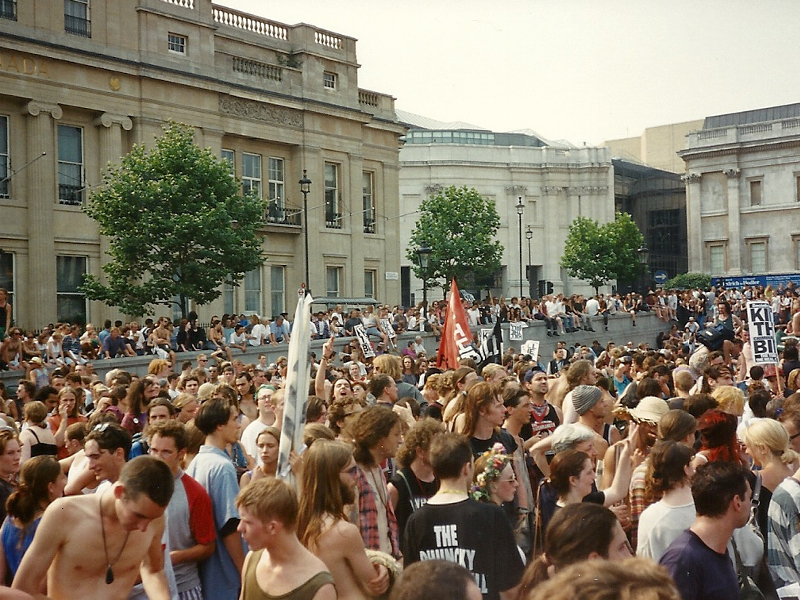
Three large demonstrations ran through London in 1994 against the bill before it passed. May Day's march ended in parties on Wanstead Common. The 24 July march drew an estimated 50,000 people by organisers' count, ended in the Claremont Road squats, and included Tony Benn speaking in Trafalgar Square - accounts from the day describe the square roaring when a sound system was switched on mid-speech.
The 9 October march, from Embankment to Hyde Park, did not stay peaceful. What became known as the Battle of Park Lane saw police move on seated demonstrators, and accounts from people who were there describe real violence rather than the largely celebratory atmosphere of the earlier marches.
The sound systems and collectives behind the marches - Spiral Tribe, Exodus, Bedlam, DiY and others, organising as Advance Party and the Freedom Network - represented the same free party scene the law was aimed at. The protests did not stop the Act passing. What they did do was put on record, at scale, that the people the law targeted did not accept it quietly.
What it actually changed
Section 63 gave police real, specific powers - to direct people away from land and to seize sound equipment - that made an open-air event on the scale of Castlemorton far harder to sustain. It did not end dance music in Britain; it pushed the centre of gravity indoors, into licensed clubs and warehouse venues that could operate within the law rather than outside it. Several of the venues covered elsewhere in this section - Labyrinth, Bagley's, the raves that became Dreamscape and Fantazia - sit on either side of that line, some before the Act and some shaped by having to work around it.