The Scene
The dial: London pirate radio and the sound it built
Six hundred illegal stations, sixty of them in London, people climbing tower blocks with a record bag to do a show for nothing. How pirate radio built British dance music, what it cost, and where it went.
By On The Door team · · 13 min read
You had to find it. That is the bit that is hard to explain to anybody who came up after broadband.
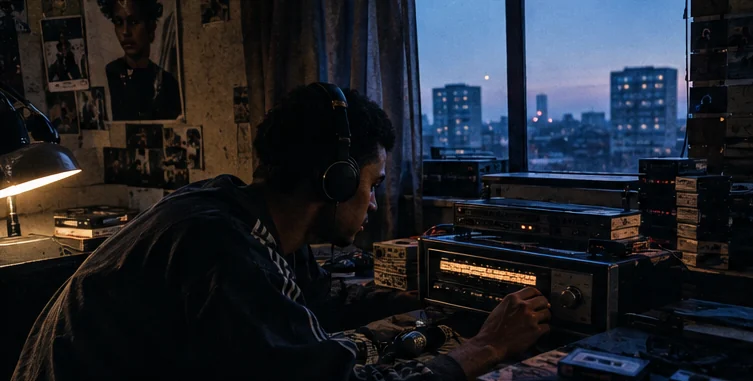
There was no app. There was no search box. Nobody was going to put it in front of you. If you wanted to know what was happening this weekend, you sat on the end of your bed with a radio on your lap and you moved through the FM band a hair at a time, through the hiss and the squeal and the stations bleeding over each other, until a bassline came out of the noise.
And when it did, you stopped dead. Because you had found it yourself.
That was pirate radio. For a lot of us in this country it was not a sideshow to the music. It was the music's whole nervous system, and it stayed that way for the best part of twenty years.
How many there actually were
People hear the word pirate and picture one bloke with a transmitter. The real number is the thing that gets you.
By the end of the eighties there were somewhere around six hundred unlicensed stations operating in the UK, and more than sixty of them in London alone. Sixty. In one city. All of them scrapping over the same few gaps in the band, all of them with a rig on somebody's roof, all of them one knock on the door away from losing everything.
That is not a fringe. That is a parallel broadcasting industry, built with no money, no permission and no safety net, and for a while it was better at finding new music than every legal station in the country put together.
Kiss got out, and it changed what people thought was possible
If you want the moment the establishment first had to take this seriously, it is Kiss.
Kiss went on air as a London pirate on 7 October 1985, covering south London at first and then the whole city on 94 FM. Gordon Mac set it up along with George Power and Tosca Jackson, and the names that passed through it in those years read like a roll call of British music: Norman Jay, Trevor Nelson, Tim Westwood, Jonathan More, Danny Rampling, Gilles Peterson.
The thing worth understanding is that none of those people were radio people first. They were in the shops, in the clubs, buying the imports, standing in the queue at the counter on a Saturday when the box came in. The station was not reporting on a scene. It was staffed by the scene.
Kiss went for a legal London licence in 1988 and lost. It went off air, it campaigned, it came back, and on 1 September 1990 it launched as a fully legal station out of Holloway Road, with Norman Jay presenting the first full show.
A pirate had walked in through the front door. Everybody noticed.
Then the music got faster and the stations became infrastructure
Acid house landed, and then rave, and suddenly the radio was not just somewhere you heard tunes. It was how the whole thing ran.
Centreforce came out of that moment as the first station in London doing rave seven days a week, around 1989 and 1990. Fantasy FM was the biggest of that first rave wave, roughly 1989 to 1991. These stations were not playing records at you. They were telling tens of thousands of people where to be on Saturday night, in a country where the authorities were actively trying to stop exactly that from happening.
Think about what the alternative was. No mobile in your pocket. No event page. No group chat. A flyer, if you were lucky, from a record shop or a mate or somebody's windscreen. A phone number on that flyer that did not go live until the evening. A voice on that number giving you a meeting point, not an address, because the address was not safe to give out yet.
And a radio, telling you which number to ring.
That is why the pirates mattered so much more here than they ever did anywhere else. They were not a music format. They were the directory.
28 November 1991
Then Kool.
Kool FM went on air for the first time on 28 November 1991, out of Banister House estate in Hackney, with the transmitter sat on a roof over at Clapton Square. Two men set it up, Eastman and Smurff. It went out on 94.5, and later 94.6, and anyone who was into it could find that part of the dial blindfolded.
Here is why Kool is the one that gets talked about more than any other. It did not arrive to document jungle. Jungle did not exist yet. What existed was hardcore, going faster and getting darker, with the breaks being chopped harder every month and the basslines getting heavier and the ragga vocals starting to come through. The station was on air while that turned into something with its own name.
By 1993 Kool was putting out something like seventy hours a week from the Nightingale Estate. Seventy hours, from a tower block, with no advertising worth the name and no licence and the constant risk of the whole lot being carted off in the back of a van.
Simon Reynolds, writing it up in Energy Flash, called Kool London's ruling pirate station, and that is about right. The DJ list over the years is absurd: Kenny Ken, Shy FX, Kemistry and Storm, the Ragga Twins, Skibadee, Navigator.
And it did not stop at the radio. By late 1992 the station was promoting its own events, and in August 1993 that became Jungle Fever. So you had the loop closed completely: the dubplate gets tested on air, the crowd reacts, the MC builds the tune's reputation on the mic, the station puts on the night, you go to the night, you hear it on a proper rig, you go home and you want the record. No label, no press, no radio plugger, no marketing budget. The scene marketing itself to itself, at speed.
That loop is the single most important thing about this era and it is the thing that gets flattened whenever somebody writes about pirate radio as a nostalgia piece.
Rush, and the tower block fortress
Weekend Rush is the other name from that Hackney cluster, out of the Nightingale Estate towers from 1991, and like a lot of these stations the frequency moves around depending on which year of tape you are holding. 92.3, 92.5, 95.2. That drift is not sloppy record keeping. That is a station moving to stay alive.
Reynolds tells one story about Rush that says more about the period than any amount of analysis. The station took over the upper floors of an abandoned east London tower block and made the way in so secure that the DJs had to climb up the outside of the building to reach the studio.
Sit with that for a second. People were scaling the side of a tower block, with a record bag, to do a two hour show for no money.
Nobody made them do that. There was no career at the end of it. There was no audience figure to wave at an advertiser. They did it because the show went out at a certain time and people were listening.
The ones the history books lost
And then there are the stations that everybody who was there remembers and almost nobody wrote down.
Life FM. Green Apple. Any number of others. Names that come straight out of people's mouths the second this conversation starts, because they were part of someone's week for years, and yet go looking for a proper documented history and there is very little there. A few tape rips on a forum. A frequency somebody half remembers. An argument in the comments about what year it was.
I am not going to invent dates for them to make this piece look tidier than the truth, because the gap is the point.
This whole culture was illegal, which meant nobody kept records on purpose. There were no accounts, no logs, no press releases, no company filings. Writing anything down was evidence. So what survives is whatever happened to end up on a C90 in somebody's loft, and what survives in people's heads.
That is why the tape archives people have been quietly digitising for the last fifteen years are not a hobby. They are the primary source. For big stretches of this, they are the only source.
Dream FM, and why two things with the same name confuses everybody
Dream FM comes up constantly and it is worth being precise, because there were two of them and people merge them.
The London one started broadcasting in January 1994 out of Battersea, having gone out very briefly as Global FM first. It was mostly happy hardcore and breakbeat hardcore, with jungle and house in there too, and in March 1995 it moved to 107.6 FM.
The Leeds one is a completely separate station and it came first. It went on air in October 1992 on 104.9, then simulcast on 99.9, settled on 99.9, and moved to 107.8 in early 1994.
Two stations, same name, different cities, different sounds, different crowds. Both real.
That is a small thing, but it is the sort of detail that tells you whether somebody was actually in it or is working off a Wikipedia tab.
Don FM, and the first crack in the wall
Don FM started broadcasting in November 1992 on 105.7, and it has a claim worth knowing: it was the first jungle pirate to be granted a temporary legal licence.
Temporary. A few weeks of being allowed to exist. But it was the first time the authorities looked at a jungle station and treated it as something other than a nuisance to be prosecuted, and everything that happened later, Rinse getting a real licence, jungle and drum and bass ending up on national radio, Mercury Prizes, all of it runs back through moments like that one.
The tape
If you heard something on air that took the top of your head off, you had one option. You had the pause button down on a cassette deck, and you had to hit record fast enough.
So that is what people did. You taped the show. You taped over your mum's tapes. You wrote the station and the date on the inlay in biro. You copied it for a mate and he copied it for two more and somebody took one home to Bristol or Cornwall or Leeds in a glovebox.
A station with a transmitter range of a few miles ended up with listeners hundreds of miles outside its footprint, because the distribution network was teenagers in cars.
No platform. No upload. No play count. The tune travelled because somebody thought it was worth the forty minutes it took to dub a copy.
Now the honest part
Nostalgia will happily sand the edges off all of this, and it should not.
Unlicensed broadcasting was a crime and still is. The Broadcasting Act 1990 brought in up to two years inside, unlimited fines and confiscation of equipment, and it is no accident that the scene thinned out for a while straight afterwards.
And it was not a victimless technicality either. Ofcom's position, then and now, is that the transmitters are frequently homemade, badly designed, bought through the black market and bolted onto the roofs of high rise blocks. Between April and September 2008, Ofcom field engineers looked into thirty six reports of interference to emergency and critical services traced to illegal broadcasters, most of them from the fire service and from National Air Traffic Services. In one of those cases the interference was affecting aircraft using Heathrow, and the source was an illegal station.
That is not a detail you skip over because it spoils the story. Somebody climbing on a roof they should not be on, with a rig nobody competent built, can sit on a frequency that matters. People doing rigging work on tower blocks have died doing it.
So both things are true at once. It was one of the most culturally productive things this country has ever produced, and some of it was genuinely dangerous and some of the people around it were not in it for the music. Anybody who was actually there knows both halves. It is only at a distance that it turns into a clean story.
The rooftops came down
What killed the FM pirate in the end was not Ofcom. It was bandwidth.
The moment you could put a stream on a server, every single reason to be on a roof disappeared. No transmitter to buy. No aerial to hide. No raid. No range limit. No having to explain to a neighbour why there is a cable going up the stairwell.
Kool went online in early 2000 and became Kool London, kept going, ended up on DAB and digital platforms, and the people who started it in 1991 handed it over after more than thirty years. Rinse, which had been a pirate since 1994, came the whole way: it was awarded a community FM licence in June 2010, written specifically around young people living and working in central, east and south London.
Read that licence wording again. The regulator, in an official document, describing exactly the audience the pirates had been serving illegally for twenty five years.
The scene did not get let in. It wore them down.
What we gained and what we quietly lost
I am not going to pretend the old way was better. It was not. It was worse at almost everything.
You missed things constantly. You heard a tune once and then never again, and there was no way on earth to find out what it was. You turned up to things that were not happening. You drove to places that had been shut down two hours before. You lost whole nights to bad information. Anybody telling you that was charming has forgotten what it was like to sit in a lay by at one in the morning with no idea where anybody is.
What we have now is better. A set goes up and the world can hear it. A promoter can put a night in front of exactly the right people. A tune gets identified in four seconds. An artist can put a record out with nobody's permission.
But there is one thing that has not survived the upgrade, and it is worth naming.
Nothing is unknown any more.
You cannot really stumble on something now. The tracklist is posted. The venue has four hundred photos. The DJ has a page. The algorithm has already decided what you are and it is quietly steering you back towards it. Discovery is now a service somebody provides to you.
Back then you were the algorithm. You did the work. You moved the dial, you taped the show, you rang the number, you drove. And because you did the work, when it was good it belonged to you in a way that a recommendation never quite does.
That is not nostalgia for worse technology. That is noticing that effort and ownership are connected, and that we have engineered a lot of the effort out.
It did not die, it changed carrier
Here is what I actually think the pirates proved, and it has nothing to do with radio.
People do not just want music. They want to know where their people are going to be.
Every single pirate station was answering that question. What is on, who is playing, where is it, how do I get in. The music was the proof you were in the right place. The information was the product.
That is still the job. The carrier changed from a transmitter on a Hackney roof to a server, and from a server to the phone in your hand, and the job has not moved an inch. Somebody is still trying to tell somebody else that there is something good on and they should come.
So the sound did not go anywhere. It is in jungle and drum and bass, obviously, but it is also in the way a promoter in a city with two decent venues will still put a night on knowing it might not break even, because the alternative is nothing happening at all.
The frequencies became URLs. The flyer became a listing. The bloke abseiling up the tower block became whoever is up at two in the morning uploading next month's lineup.
Same instinct. Better tools. The dial just lives somewhere else now.
Have a look at what is on tonight, or what is coming up this weekend. Find one you have never heard of. That is the only part of this you still have to do yourself.